42-96030
Crashes > of the USAAF
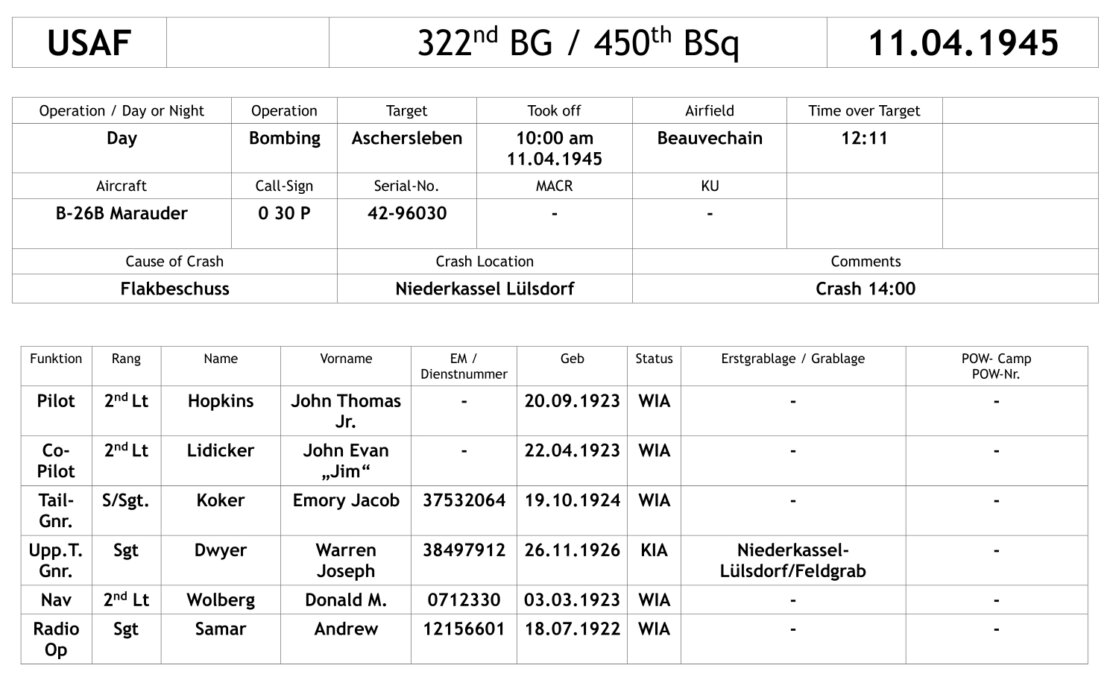
Foreword to the Research on the Crash of Flight 42-96030
A few years ago, I learned about a student project at the Kopernikus Gymnasium in Lülsdorf concerning the end of the war in Niederkassel. This 1995 documentary, among other things, reports on an airplane crash that allegedly occurred on April 11, 1945, on the outskirts of Lülsdorf.
This event is documented exclusively in the Lülsdorf school chronicle. This piqued my curiosity to find additional historical sources that confirm this crash and the events surrounding it.
Initial research led me to the Niederkassel City Archives, where I was able to view the original school chronicle. Unlike many other church and school chronicles, this one was not altered after 1945 by rewriting various pages or removing pages from the Nazi era.
This can be seen, among other things, in the consecutively numbered pages of the blank chronicle; furthermore, the binding is completely intact and undamaged. The head of the archives also confirmed to me that this chronicle had not been altered or tampered with. The events of the final days of the war in Lülsdorf are recorded there very promptly and are therefore entirely credible.
However, the plane crash on April 11, 1945, is not mentioned in the school chronicles of the neighboring towns of Langel and Zündorf. Unfortunately, despite repeated requests, I was unable to view the church chronicles of Lülsdorf or Langel to find any possible mentions of the events there.
Research in the district and city archives in Bergisch-Gladbach, in the City of Cologne’s archives (including the holdings of the former Porz City Archives), and in the State Archives in Düsseldorf also yielded no reference to the crash.
Actually, all crashes involving American aircraft during World War II are quite well documented in American military archives and in the National Archives in Washington. Despite months of searching through these archives and reviewing countless documents, no crash in the Cologne area was recorded for April 11, 1945.
So there was no progress here; the search had to continue in a different direction. Every detail of the entry from the school chronicle had to be systematically checked and questioned, every minor detail critically examined.
And so the first step was to determine what type of aircraft it might have been. The chronicle mentions six people on board the aircraft. This ruled out the large American B-17 and B-24 bombers, as they typically flew with a larger crew. In the end, only one possibility remained: it must have been a B-26 bomber.
I contacted various online forums dedicated specifically to the history and deployment of this aircraft type during World War II.
After countless emails and phone calls, Trevor Allen from B26.com, an English historian and B-26 expert, shed some light on the matter. He wrote to me about a crash on the day in question, but noted that the crash site was recorded as “near Bonn.”
He provided some names of the crew, the aircraft number, and other details that should have made further research straightforward. But far from it—months passed and I spent hours upon hours at the computer, yet no new insights emerged. The aircraft and its crew were not listed anywhere; it was exasperating.
I then posted my findings on an international aviation forum and asked if anyone knew anything about this story. There, I was directed to a book published in the U.S. that recounts the history of the 322nd Bombardment Group. And there I found the After Action Report (daily report) of the 450th Squadron for April 11, 1945; it confirmed the crash and listed the names of the crew. They were the same names that Trevor Allen had given me.
Below:
The original page from the Lülsdorf School Chronicle detailing the events of April 11, 1945
With the help of a historian in the U.S., I gained access to military documents from the 322nd Bombardment Group and the 82nd Airborne Division, which was stationed on the left bank of the Rhine, witnessed the crash at the time, and later took charge of the injured crew. In these documents, I found all the essential details about the flight, the crash, and the rescue of the injured crew.
Now all that remained was to sift through and translate a few thousand documents. And so, piece by piece, the puzzle of the events of April 11, 1945, was finally solved.
Today, after nearly four years of intensive research, I can document the story of the flight, the crash, the rescue, and the handover of the wounded crew to the American forces of the 505th Parachute Infantry Regiment on the other side of the Rhine almost minute by minute.
The following account tells the story of a plane crash, of which there were thousands during World War II, on both the German and Allied sides.
But this one crash and its aftermath were so unusual that it even found its way into American literature. Martha Gellhorn, the American journalist and war correspondent, witnessed it firsthand. And she felt this experience was worth recording and publishing.
In her book *The Face of War*, published in 1959, she included the events of April 11, 1945, in Lülsdorf in the article “The German People.”
Introduction to the Events in and Around Cologne in March and April 1945
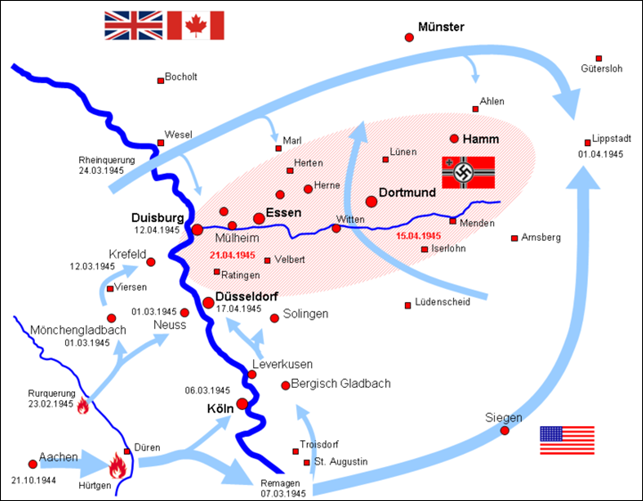
On March 6, 1945, American troops advanced from the direction of Cologne-Ehrenfeld and Lindenthal toward Cologne Cathedral and the Hohenzollern Bridge. Starting on March 3, nearly all German combat units had retreated to the right bank of the Rhine via ferries and taken up positions there. On March 7, the left bank of Cologne was captured, and American troops reached the Rhine. On March 8, American troops from the 104th Infantry Division and the 8th Infantry Division occupied the Urfeld-Wesseling-Sürth and Weiß area on the left bank of the Rhine.
On March 7, the 9th U.S. Armored Division succeeded in capturing the undamaged Rhine bridge at Remagen. This gave American troops the opportunity to establish a bridgehead on the right bank of the Rhine. In the coming weeks, they advanced to a line between Siegburg and Siegen and in a wide arc as far as Lippstadt.
On March 24, British and Canadian units crossed the Rhine near Wesel and advanced further into the German hinterland north of the Ruhr region, joining forces with American troops near Lippstadt on April 1. As a result, approximately 300,000 soldiers of Army Group B and millions of civilians were trapped in an area that was, in parts, completely destroyed.
In early April, the American 82nd Airborne Division is transferred from Sissone, France, to the left bank of the Rhine to relieve the forces of the 86th Infantry Division stationed there. The troops are transported to the Rhine by train and road. Starting on April 4, the 325th Glider Infantry Regiment occupies Cologne on the left bank of the Rhine, from Riehl to the bend in the Rhine north of Weiß. Opposite Langel is now the 505th Parachute Infantry Regiment. It secures the towns on the right bank of the Rhine from Porz to Niederkassel along a line stretching from Weiß to Wesseling.
As of March 7, the front has now reached the right bank of the Rhine.
The German Wehrmacht units on the right bank are in a desolate state, exhausted and mostly without heavy weapons. There is a shortage of food, fuel, and ammunition. Many units consist of a motley crew of personnel from various branches of the military, stragglers, and a completely unmotivated Volkssturm, which lacks any combat experience.
The advancing American forces have driven the German troops across the Rhine, causing them to suffer enormous losses in personnel and equipment.
Now, the advancing tank units of the 13th U.S. Armored Division, coming from Sieg toward Troisdorf, Sieglar, and Niederkassel, are pushing the German units further and further back into the existing Ruhr Pocket.
Below:
The situation of the Wehrmacht around April 11, 1945 / Source: de-academic.com
The residents of Uckendorf, Ranzel, Lülsdorf, and Langel are literally overrun by the retreating German troops. The soldiers are quartered in schools, inns, and on farms. In many places, this leads to looting and vandalism by Wehrmacht soldiers.
Although the bombing raids have subsided, the towns along the Rhine have been subjected to artillery and mortar fire since early March. American troops regularly shell the right bank of the Rhine; no one is safe from the impacts and shrapnel. Several residents of Langel and Lülsdorf are killed or wounded as a result. Over forty German soldiers, who were stationed here or were trying to reach the right bank of the Rhine, lost their lives in Langel alone.
Regular cultivation of the fields is impossible due to the shelling and snipers; anything moving near the riverbank is a potential target for American soldiers.
School classes have not been possible for weeks; people are living mostly in basements and makeshift bunkers. For example, the Langel pastor, Kallenbach, is living with a few parishioners in the basement of the parsonage, which has been converted into an air-raid shelter.
By early April, the shelling grows increasingly intense; only a few German units remain in the Rhine bend between Zündorf and Lülsdorf. Everything is in disarray and in retreat; unified military command no longer exists, and everyone is trying to save themselves. The population hopes for a swift end to the war and a rapid advance by American forces.
Then came the events of April 11, 1945, and despite all the suffering that had become daily routine, a few people on both sides of the Rhine would bring the war to a halt for a full hour. Compassion, care, and humanity would return, making people forget who was friend or foe.
Beauvechain Airfield in Belgium.
Built by the Belgian armed forces in 1936, the airfield was captured by the German Wehrmacht during the Western Campaign. Several Luftwaffe fighter wings were stationed at Le Culet, as it was known at the time. In the run-up to the Allied invasion of Normandy on June 6, 1944, the airfield was bombed by the 8th U.S. Air Force in early 1944. After the American forces captured Belgium, the 9th Air Force used the airfield as a base for fighter and light bomber groups from October 1944 to June 1945, following six weeks of repairs.
Starting in March 1945, the American 322nd Bombardment Group (M) was stationed here. It consisted of the 449th, 450th, 451st, and 452nd Squadrons.
Named after their commander, COL Glenn C. Nye, the crews called themselves “NEY’S ANNIHILATORS.”
The 322nd BG flies exclusively the B-26 Marauder light bomber.
Two Pratt & Whitney Twin Star engines, each with 1,920 horsepower, enable it to reach a maximum speed of 455 km/h at an altitude of 1,530 m (5,019 ft).
At an altitude of 15,000 feet, it still reaches 441 km/h, and its service ceiling is 19,800 feet.
Its armament consists of eight 12.7 mm Browning machine guns, and it can carry a bomb load of approximately 1.8 tons.
The crew consists of 6 men. Originally there were 7, but in 1944 the tunnel gunner—who stood in the fuselage and operated two machine guns through the side openings on both sides—was eliminated.
Above:
Beauvechain Airfield in the winter of 1944–45 / Source: http://www.belgian-wings.be
Above:
B-26 B Marauder / Source unknown, Weichert private archive
The Attack on Aschersleben
On April 11, 1945, at 7:15 a.m., 44 crews from the 322nd BG gathered at Beauvechain Airfield for a briefing. The target of the planned attack is Aschersleben, a town on the northeastern edge of the Harz Mountains. Here, the Junkers factory and Ascherslebener Maschinenbau AG, as well as extensive railway facilities, present a valuable target for the American bomber group.
Takeoff is scheduled for 10:00 a.m., with a return to base planned for 1:44 p.m. The attack will be carried out in three aircraft groups, each consisting of six so-called “boxes.” Each box, in turn, consists of six B-26 bombers flying in tight formation.
In the second group, left box (red circle), the B-26 42-96030 030 P, piloted by 1st Lt. John Hopkins, is flying in the center. Despite being only 22 years old, he has already gained a great deal of experience in several attacks on targets in Germany. His co-pilot, 2nd Lt. John Lidicker, is the same age, as is the navigator and bombardier, 2nd Lt. Donald Wolberg. The radio operator is 23-year-old Sgt. Andrew Samar. The tail gunner is 21-year-old S/Sgt. Emory Koker. In the turret sits the youngest member of the crew, 18-year-old Sgt. Warren Dwyer.
Source: Swank Archive, Bloomington
At exactly 9:40 a.m., the engines of the 44 aircraft are started; ten minutes later, the B-26s taxi onto the runway. Right on time at 10:00 a.m., the first bombers take off from the runway. The weather is almost cloudless; it promises to be a smooth flight. After all, the approach to the Rhine takes place over “friendly” territory—that is, territory occupied by their own troops. As long as the aircraft do not approach the Ruhr Pocket with its roughly 300,000 trapped Wehrmacht units, heavy anti-aircraft fire is not to be expected.
Above:
Flight paths: The approach route in the center, with the alternate return route below, passing over Marburg and Giessen toward Cologne
Source: Swank Archive, Bloomington
The approach route takes them over Belgium to Zülpich and Hillesheim, which they fly over at 11:03 at an altitude of 6,000 feet. One aircraft (397 A) from the 3rd flight, piloted by 2nd Lt. Behnke, reports mechanical problems, breaks formation, and flies back to base. This leaves only five aircraft in this flight en route to Aschersleben. Half an hour later, they reach Giessen, where all aircraft rendezvous and climb to an altitude of 10,000 feet.
At exactly 12:11 p.m., the target of Aschersleben is reached; the aircraft of the first group drop their respective eight 500-pound (approx. 227 kg) bombs, which explode on the ground seconds later. After a right turn past Aschersleben, they fly a loop and head back toward Gießen.
The second group reaches Aschersleben minutes later. However, due to the previous bombing by the first group, the target area is completely obscured from the view of the pilots and bombardiers by smoke and dust. So the group decides to attack a primary target, a railway junction in Güsten, about 70 km east of Aschersleben.
On the flight there, however, the lead aircraft’s bomb sight (PDI) fails, making a precise bomb drop impossible.
And since the following aircraft do not drop their bomb load until the lead aircraft equipped with the PDI releases its bombs, all five aircraft take their bombs back with them on the return flight.
It can now be assumed that, due to this alternate target and unclear navigation by the lead aircraft, the formation flies a turn that is too sharp to the right. Although the direction toward the return route is correct, it is offset by a good 20 km to the south. When they realize their mistake, they repeatedly request guidance in the form of bearings. But even this assistance fails due to technical problems. Thus, they fly parallel to the actual return route toward Gießen.
About 10 km south of Marburg, they make a sharp 90-degree turn to the right, flying over Marburg and Giessen, before correcting their course again and turning approximately 45 degrees to the left. This puts them back on the correct return route, but shifted a good 30 km to the south.
And so the five aircraft come very close to the outer edge of the Ruhr Basin and the anti-aircraft guns still stationed there. And thus the fate of the crews takes its course.
The five B-26 bombers fly side by side at a considerable distance from one another, at various altitudes ranging from 5,000 to 2,500 feet. The B-26 42-96030 030 P, piloted by 1st Lt. John Hopkins, flies at approximately 2,500 feet on the right edge of the formation. At 1:45 p.m., it flies over the Wahner Heide and comes under light anti-aircraft and machine gun fire near Wahn. Anti-aircraft shrapnel penetrates the aircraft and shreds the right thigh of Warren Dwyer, who is sitting in the turret. In the process, the artery in his leg is also torn, causing severe blood loss.
The left engine begins to smoke, and fire breaks out at the leading edge of the wing and the right engine nacelle. Hopkins knows he has only two options: Either the entire crew bailes out here and tries to save themselves with parachutes. Dwyer, however, would have no chance due to his severe injuries.
Or he attempts an emergency landing. This option has a major drawback: the aircraft is still loaded with eight bombs, which he must jettison as quickly as possible. No one on the crew would survive a crash landing with the bombs on board.
Meanwhile, the right engine is engulfed in flames. Hopkins pulls a sharp left turn, opens the bomb bay, and drops his bomb load between the fields of Weilerhöfe and Uckendorf. However, most of his bombs strike the center of Uckendorf. After four violent explosions, the center of Uckendorf is engulfed in flames.
Hopkins continues the left turn, causing the aircraft to lose altitude rapidly. Between Wahn and Zündorf, he ends the left turn and flies toward Langel and Lülsdorf in a shallow dive.
Eyewitnesses
At this time, 25-year-old 2nd Lt. Jacques J. Saunder is sitting in his quarters on the left bank of the Rhine in Wesseling, reviewing interrogation transcripts of German Wehrmacht personnel. The 505th PIR had captured these German soldiers in recent days during nighttime patrols on the right bank of the Rhine.
Lt. Saunder belongs to a special unit of the 82nd Airborne Division responsible for psychological warfare and, in particular, for the interrogation of German prisoners of war. Saunder speaks fluent German, as he was born and raised in Berlin in 1920 to Polish parents under the name Jacob Szuchman. In November 1938, he and his parents left Germany and emigrated to the United States via Antwerp on the ship “NIEUW AMSTERDAM.”
They settled in New York, where Szuchman worked as a laboratory technician. In November 1942, he received American citizenship and took the name Jacques Saunder. As early as August 1941, he enlisted as a volunteer in the U.S. Army Signal Corps.
It is thanks to Saunder that the following events were recorded in writing in full detail.
Staying at the same lodging is the well-known American journalist Martha Gellhorn, who, as a war correspondent, had accompanied the 82nd Airborne Division from France to Germany. Gellhorn, 37, married to Ernest Hemingway since 1940, began her career as a war correspondent with reports on the Spanish Civil War and writes for the prestigious American magazine Collier’s.
She also witnesses the events that follow and publishes this story for the first time on May 26, 1945, in Collier’s. She goes into far greater detail about these events in her book *The Face of War*, published in 1959.
The crash of the B-26, the rescue of the crew, and the aftermath
At 2:00 p.m., the aircraft crashes into a field on the outskirts of Lülsdorf and bursts into flames. A huge, black mushroom cloud hangs over the crash site.
The crash site is pinpointed quite accurately by American units; it is located in an area that is now built up, between Bachstrasse, Rothgässchen, and Elly-Ney-Strasse.
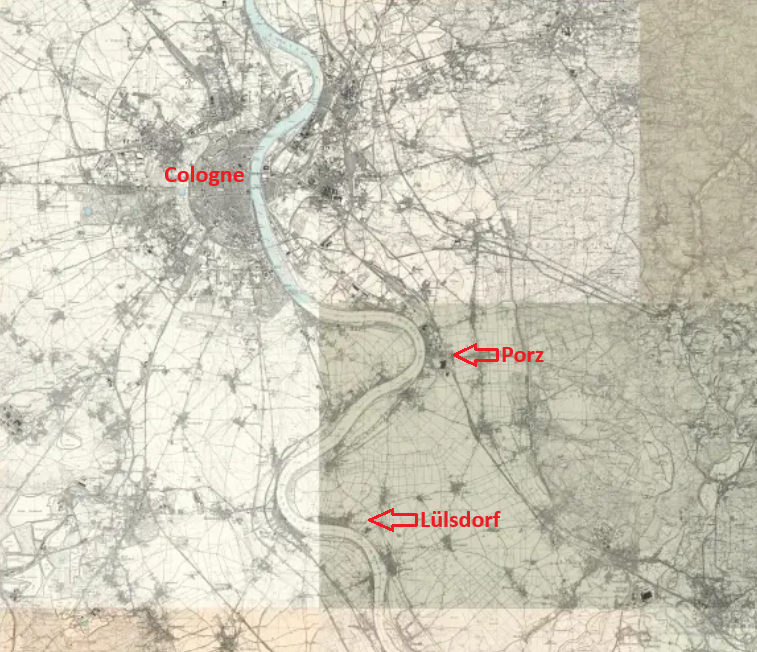
Soldiers from the nearby anti-aircraft gun emplacement and several civilians from Lülsdorf immediately rush to the crash site. Upon impact, some crew members were thrown from the aircraft and now lie scattered around it. Others, such as pilot John Hopkins, co-pilot John Lidicker, and turret gunner Warren Dwyer, are trapped inside the burning aircraft and are rescued by the German soldiers and civilians.
Warren Dwyer suffered severe injuries to his thighs and legs and succumbed to his injuries. It is no longer possible to determine today whether he died before or after the crash. He was buried by local residents in the immediate vicinity of the aircraft wreckage. When he was exhumed on April 16, 1945, by American units that had since advanced, his right thigh was tied off with a belt to stop the bleeding at the time. However, this belt was not part of his uniform. It can therefore be assumed that this belt was applied by a German soldier or civilian and that Dwyer was still alive after the crash.
However, Dwyer’s dog tag was missing during his exhumation; it was most likely removed before the burial. Normally, a part of the dog tag always remained with the fallen soldier, which made identification possible. This was not the case here, and thus, following his exhumation, Dwyer was taken to the American military cemetery in Idstein as an “unknown soldier” and buried there.
Hopkins and Lidicker were seriously injured and suffered severe burns, as did the navigator Wollberg, who also sustained a broken elbow. The radio operator, Andrew Samar, suffered severe facial injuries, a broken leg, and serious injuries to his hands.
The tail gunner, Emory Koker, sustained only a bruised chest but went into severe shock and ran headlong toward the village of Lülsdorf.
It is now 2:15 p.m.; more people have arrived at the crash site and brought stretchers with them. The four injured crew members are given first aid, placed on the stretchers, and carried to the village of Lülsdorf. The Americans on the left bank of the Rhine view this operation with suspicion, but they neither intervene nor fire on the German group.
Only one paratrooper from B Company gets into a boat around 2:30 p.m. and crosses the river on his own initiative and without orders to retrieve the crew. He lands on the Lülsdorf bank and walks along the riverside road toward the town center. Here he comes under fire from the Germans, jumps into a shell trench, and reemerges with a prisoner. He walks with his prisoner to the river, climbs into another boat, and rows back to the left bank. After about 50 meters, he turns back because the boat is filling with water and threatens to sink. He drags his prisoner back to shore, walks 300 meters along the beach to his original boat, and returns to the left bank of the Rhine. Here, at 3:30 p.m., he hands his prisoner over to the 505th PIR.
Around 4:00 p.m., the group carrying the wounded American soldiers reaches the outskirts of Lülsdorf. However, there is no doctor available here who could tend to the seriously wounded American soldiers. Only a Belgian forced laborer, who works as a medic at the Feldmühle factory, has rudimentary knowledge of first aid for the wounded.
Eugene Bosman, who is only 19 years old and has been working as a foreign laborer for several companies in Germany since 1941, lives with his father at the “Bröhl” inn in Lülsdorf and works at Feldmühle AG in Lülsdorf. He selflessly tends to the wounded and sends for the pastor, Dr. Johann Koch, and Maria Erven, who works as a nurse’s aide. He wants to prevent the German soldiers still in Lülsdorf from learning of this incident and taking the wounded as prisoners of war—or worse.
This is exactly what happened to Emory Kocker as he runs toward the village of Lülsdorf, completely in shock. Civilians intercept him and escort him to the village center. There, he is immediately surrounded by a group of German soldiers and taken prisoner. The Germans are preparing to leave and want to retreat toward Porz, as the first American tank units are already in Troisdorf and Spich and are advancing toward Wahn. The noise of the fighting and the clatter of tank tracks can already be heard as far as Niederkassel.
They discuss what to do with the wounded American soldiers. Pastor Dr. Koch suggests contacting the American units on the other side of the Rhine. This undertaking is not without risk, as the Americans are firing at anything that moves along the riverbank.
However, since the B-26 crashed, not a single shot has been fired, so they decide to go to the riverbank with white flags. Led by Pastor Dr. Koch, several civilians, two soldiers, and the Belgian foreign worker Bosman go to the riverbank and ask the Americans to come and retrieve their wounded comrades. They agree to keep their weapons silent during the rescue operation.
For quite some time, the Americans remain in cover on the left bank of the Rhine, fearing an ambush.
Around 5:30 p.m., 1st Lt. Novik leaves the division command post of the 505th PIR. There, he meets the S-2, 2nd Lt. Saunder, and discusses the next steps with him. Saunder, too, is skeptical of the operation involving the white flags, fearing a German ambush. On the other hand, they have been able to observe the Germans’ rescue efforts for their downed comrades. Lt. Novik goes to the 1st Company on the Rhine bank and uses a megaphone to make it clear to the Germans that they should remain calm and lay down their weapons for the duration of the rescue.
At 6:00 p.m., Lt. Novik crosses the Rhine in a boat with a few soldiers. The Germans remain calm and friendly and help the Americans load the four wounded men into the boat. German soldiers, who are offered the chance to surrender as prisoners of war, firmly reject this proposal. And the Americans take no action; it would have been easy for them to disarm the German soldiers and take them aboard the boat. At 7:10 p.m., the Americans return to the left bank of the Rhine, where the wounded are handed over to the 307th Airborne Medical Battalion.
Above:
Excerpt from the AAR (After Action Report) of the 322nd Bombardment Group regarding the flight to Aschersleben.
Above that:
An original report by a crew that witnessed the crash. They saw Hopkins’s aircraft catch fire, crash, and explode. Here, too, the crash site is listed as “near Wahn.”
Source for 322nd BG: AFHRA / CD B0241
Both reports list the incorrect coordinates 550450 and 550500 (Wahn) as the crash site. The information was recorded immediately after the aircraft returned to base by several crews who had observed Hopkins’ crash. These reports formed the basis for the After Action Report.
Below:
The following are some daily records of the 82nd Airborne Division, as recorded in its G-2 report.
Here, various units of the 82nd Airborne Division, such as the 505th Parachute Infantry Regiment and the division’s artillery, recount their immediate impressions of the crash of Lt. Hopkins’ B-26.
The reports were compiled on April 11, 1945, between 2:10 p.m. and 8:40 p.m.
In the DIV.-ARTY report from 2:10 p.m., the exact crash site is first specified with the coordinates 4780 4830 (Map Sheet 5108 / Scale 1:25,000).
The 505th PIR report from 2:40 p.m. simply states the crash site with the coordinates 480 485.
At 3:00 p.m., the 505th PIR documents the assistance provided by the civilian population during the rescue operation.
It is also noted at 2:45 p.m. that the town of Uckendorf is in flames. The most likely cause of this was the emergency drop of bombs by Hopkins prior to the crash.
Source: G-2 Journal and Message file for 7 April to 28 May 1945, 82nd Airborne Division
https://mcoepublic.blob.core.usgovcl / D97 I2031.pdf
Below:
Finally, the report by Lt. Novik, who arranged for the rescue of the injured crew. In his report, he notes that one crew member likely fell into German captivity unharmed.
Source: G-2 Journal and Message file for April 7 to May 28, 1945, 82nd Airborne Division
https://mcoepublic.blob.core.usgovcl / D97 I2031.pdf
Martha Gellhorn, the American war correspondent, recounts the crash in her book:
“THE GERMAN PEOPLE” and describes the rescue operation in the following words:
.....at six o’clock, one of the strangest episodes began that anyone had ever experienced in this war, and there were some men present who had survived all four airborne operations of the 82nd Division and the Battle of the Ardennes and could rightly claim to have seen it all.On the green embankment on the other side of the Rhine, someone began waving a white flag. No one paid any attention to it, because that didn’t necessarily mean anything. Then a procession made its way down to one of the landing stages. They were carrying a Red Cross flag. Through our binoculars, we could make out a doctor, a priest, and two German soldiers carrying a stretcher. A landing craft set off from our bank, well covered by our machine guns in case the whole thing was a macabre joke. Immediately, a crowd gathered on both banks of the Rhine; normally, no one moved about in this area during daylight hours, and even at night people were on their guard. Now we stood in the sun, watching in amazement. Slowly, three more stretchers were carried down toward our boat. We could make out civilians, children, German soldiers; everyone was staring at everyone else. We couldn’t believe what we were seeing and were still ready to take cover at a moment’s notice. Then the small boat was pushed out into the current...the boat landed, and our doctor, who had rowed over, shouted that we should clear the shore; the Krauts had said they would give the medics time to unload before opening fire. The war had stopped for about an hour along this hundred-meter front...
The war seems to be over, for not a single shot is fired anymore, neither by the Americans nor by the German soldiers. The latter are busy getting to safety as quickly as possible, since the first American units are already on their way toward Wahner Heide via Troisdorf and Spich; it can only be a matter of hours before the first American soldiers enter Lülsdorf.
And the artillery fire from the left bank of the Rhine has also ceased; the night passes in complete calm. Only the rattle of German tank tracks can be heard on the road from Lülsdorf to Langel, as more and more Wehrmacht units make their way toward Porz and Cologne-Mülheim.
Thus, the group that has captured Emory Koker (likely members of the 3rd Parachute Division) also sets out on the morning of April 12 and leaves Lülsdorf with their prisoner, heading toward Porz. The road is full of trucks and tracked vehicles, but most soldiers are on foot, ragged and hungry, some without weapons and without any leadership. And they are constantly in danger of coming under fire from low-flying American fighter planes.
The group reaches Zündorf, where they hand Emory Koker over to an SS officer. This is an SS unit assigned to guard a large group of prisoners from the Weimar-Buchenwald concentration camp.
These prisoners are performing trench work on the banks of the Rhine and laying minefields. They are housed in several cattle cars parked on the tracks of the narrow-gauge railway in Zündorf.
This SS officer interrogates Koker and then orders him to be shot immediately. Another officer then leads him behind a building and tells him to remain calm. The German officer told him that he (the officer) just wanted to go home and that the Americans were already nearby. He then fires a bullet into the dirt next to Koker, walks forward, and loudly reports that the order has been carried out. A few hours later, the first American units advance from Wahn to Zündorf; Emery Koker, who had been hiding the entire time, is safe.
The Crew Members and What Became of Them
All surviving crew members were seriously injured and were initially treated by the 307th Airborne Medical Battalion; they returned to the United States between April and May 1945. They were all awarded high medals for bravery and were discharged from the Army later that same year.
All crew members have since passed away; descendants of only two members could be located in the United States.
And here, as in Germany, the fathers did not speak about their wartime experiences; even their wives knew few details about their husbands’ lives during that time. And so it was not entirely easy to tell the crew’s story after the war.
Pilot 2nd Lt. John T. Hopkins, born on September 20, 1923, in Washington;
had suffered burns to his legs and arms. After his recovery, he returned to his hometown of Washington and married on March 15, 1947; the couple had four children.
A trained cartographer, he joined the U.S. Surveying Authority in 1947 and became head of the Survey Project’s illustration office in Kentucky in 1961. In 1969, he returned to Washington, D.C., where he became deputy director of cartography.
On August 8, 1978, Hopkins died of cancer in Leesburg at the age of 54.
Co-pilot 2nd Lt. John Evan Lidicker, born on March 22, 1923, in Highland Park, Illinois;
suffered severe burns over his entire body in the crash. After months in the hospital and numerous surgeries, he was discharged but remained partially disabled for the rest of his life. Lidicker was the descendant of German and Welsh immigrants and grew up in the suburbs of Chicago. He developed an interest in flying at a young age, took flying lessons, and enlisted in the Air Force during the war.
After the war, he opened a photography studio specializing in advertising and magazine photography in Chicago; during the final years of his working life, he was employed as a technical draftsman.
Lidicker passed away on November 28, 2007, at the age of 84 in Jacksonville.
Tail Gunner Sgt. Emory Jacob Koker, born on October 19, 1924, in Columbia, Ohio
He survived the crash with only minor injuries; he sustained nothing more than a bruised chest. However, he also suffered severe shock, which caused him to run away from the crash site toward Lülsdorf in a complete panic after the crash. There, he was captured by German soldiers and freed by American troops a day later.
After his liberation in Zündorf, he too was first taken to the hospital of the 307th Airborne Medical Battalion and soon returned to the United States. On October 3, 1945, he was discharged from the Army; he was also awarded the Purple Heart and the Air Medal.
After the war, he worked for many years as a courier for the Atomic Energy Commission (AEC). During this time, he met his future wife, whom he married on June 12, 1948. The marriage produced one son, Mark Koker.
Throughout his life, he stayed in touch with his comrades who had survived the crash with him. He shared a lifelong friendship in particular with John Hopkins and Andrew Samar. Emory Koker passed away on May 5, 1999, at the age of 74 in Springborn, Ohio.
Radio Operator Sgt. Andrew Samar, born on July 18, 1922, in Hastings, NY
He survived the crash with severe burns to his face and hands and a broken leg. He, too, was transferred to a field hospital and continued to suffer from his injuries for years after the war. He married in the late 1940s; unfortunately, nothing is known about his life after the war.
Andrew Samar died on January 30, 1997, at the age of 74 in Somers, NY.
Navigator/Bombardier 2nd Lt. Donald Merle Wolberg, born on March 3, 1923, in Chicago,
suffered severe burns and a broken elbow in the crash. Like the other crew members, he was also transferred to a military hospital. On January 17, 1946, he was discharged from the Army with the rank of 1st Lt.
Donald Wolberg married Rita Goldstein on January 7, 1947, at the synagogue in Cook County. The couple had two daughters.
No further details about his later life, particularly his professional career, have been recorded. He most likely worked in a technical profession, as he was granted two patents for key holders in the 1950s and 1960s. He died on January 8, 1994, at the age of 70 in Kingston, Pennsylvania.
Sgt. Warren Josef Dwyer, born on November 26, 1926, in New Orleans,
was the only one who did not survive the crash. As the upper turret gunner, he was positioned in the center of the aircraft, looking out through the Plexiglas dome in the roof of the plane and operating the machine gun. During anti-aircraft fire, shrapnel from a shell pierced the aircraft’s outer skin and struck Dwyer in the thigh. His injuries were severe; he lost a great deal of blood and died shortly after the crash. He was buried in the immediate vicinity of the crash site, but his dog tag was removed.
On April 16, he was exhumed by an American recovery team and, due to the missing dog tag, buried as an unidentified soldier in Ittenbach. It was not until July 1945 that the body was identified as that of Warren Dwyer following a fingerprint comparison. He was exhumed once again and buried at the American Military Cemetery in Margraten, Netherlands.
He was posthumously awarded the Air Medal and the Purple Heart. Not yet 19 years old, Warren Dwyer died on April 11, 1945, in Lülsdorf.
From left to right: John Hopkins, Andrew Samar, John Lidicker, Emory Koker
Photo taken in the mid-1980s / Private collection