42-5828
Crashes > of the USAAF
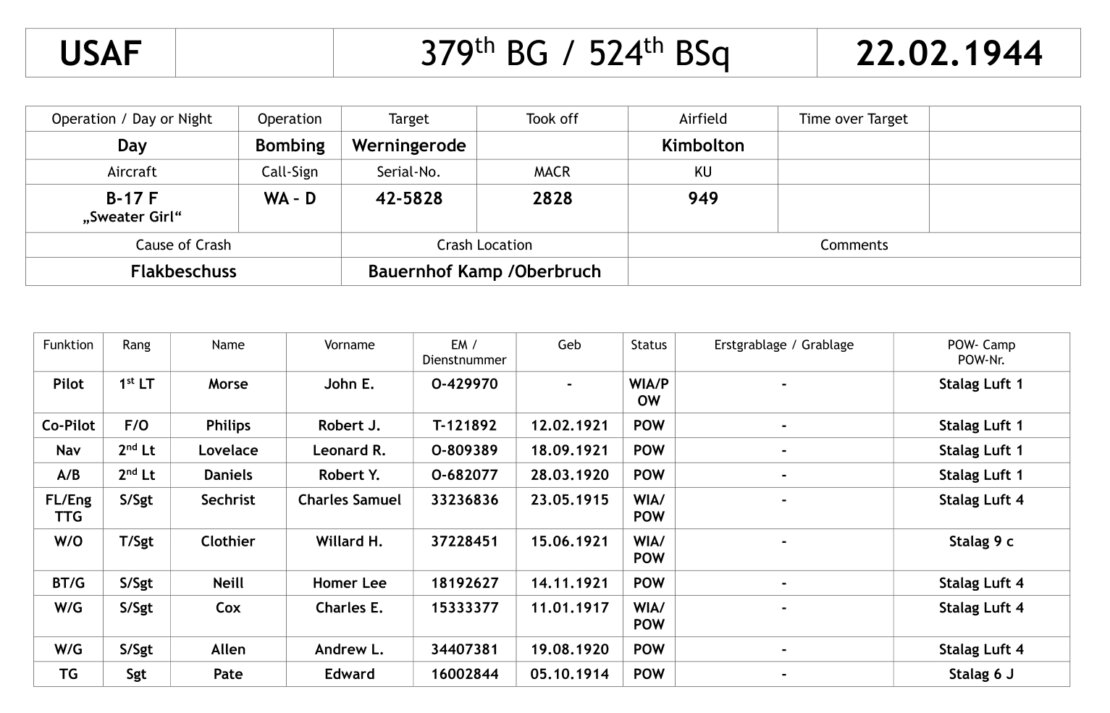
On the morning of the first day of "Big Week," 289 B-17s took off from various airfields in England to attack industrial sites in Aschersleben, Bernburg, and Halberstadt. Nineteen of these aircraft attacked the factory buildings of RAUTENBACH AG, a production facility for light metal castings in Wernigerode. It was the most violent attack the small town in the Harz Mountains had ever experienced. 192 people died in the bombing raid, over a hundred houses were destroyed and another hundred were damaged.
But this day also brought heavy losses for the USAF: 38 B-17s did not return to their bases, and over 400 American soldiers were killed or missing in action.
One of the aircraft that took part in the attack on Wernigerode was the B-17 "Sweater Girl" under the command of 1st Lt. John E. Morse, a 30-year-old former flight instructor.
At the height of Cologne, the B-17 came under heavy fire from several heavy anti-aircraft batteries. This resulted in a severe hit to the right wing and a fire inside the cockpit. The aircraft immediately broke formation and crashed in a left turn. However, the pilot managed, with great effort, to regain control of the aircraft and pull it out of its deadly dive.
The fire inside the aircraft was extinguished, but the damage was considerable. In addition, radio operator Willard Clothier was seriously wounded, with flak fragments almost completely severing his left thigh. And Edward Pate, the tail gunner, had a large hole in his ankle caused by flak fragments.
But the pilot knew that with this damage and two seriously wounded crew members, he would never make it back to Kimbolton. The only options left were to attempt a belly landing or to have the crew bail out. The wounded were given makeshift first aid and bandaged, and their comrades strapped parachutes onto them. Shortly before the Dutch border, the pilot put the plane into a slight left turn and gave the order to bail out. At an altitude of about 600 meters, everyone except the pilot left the plane. John Morse had an idea for bringing the plane down relatively safely. He strapped the rudder in place to bring the "Sweater Girl" down in a gentle, flat spiral. Then he too jumped out of the plane.
After more than a quarter of an hour, during which the pilotless aircraft flew in calm, steady descending circles, it landed behind the houses of Oberbruch, near a farm in an open field. There was no explosion and no one was injured. John Morse's flying skills had saved the lives of the crew and spared the citizens of Oberbruch from disaster.
The entire crew reached the ground, albeit some of them seriously wounded, and were taken prisoner by the Germans.
Willard Clothier was taken to the hospital in Rheinberg, where his left leg had to be amputated. He was repatriated to the US after a short time. All the others returned to the US after the war.
In 2014, citizens of Oberbruch erected a memorial in the center of Oberbruch to commemorate the events of January 1944 (see: www.limburg-bernd.de).
Additional sources:
My sincere thanks to:
Helmut Frenken from Oberbruch for the photos of the memorial.
Paul Philips, son of F/O Robert J. Philips, for the photos of the crashed B-17.
Above:
The crash site near Oberbruch
Below:
The crash site in Oberbruch
Below:
I owe the four photos of the crashed wreck to Paul Philips,
the son of F/O Robert J. Philips.
Top left:
B-17 flying in formation, with the WA-D "Sweater Girl" in the center.
Top right:
The crew of the B-17 "Sweater Girl."
Bottom:
The memorial in Oberbruch commemorating the crash on February 22, 1944.