42-31900
Crashes > of the USAAF
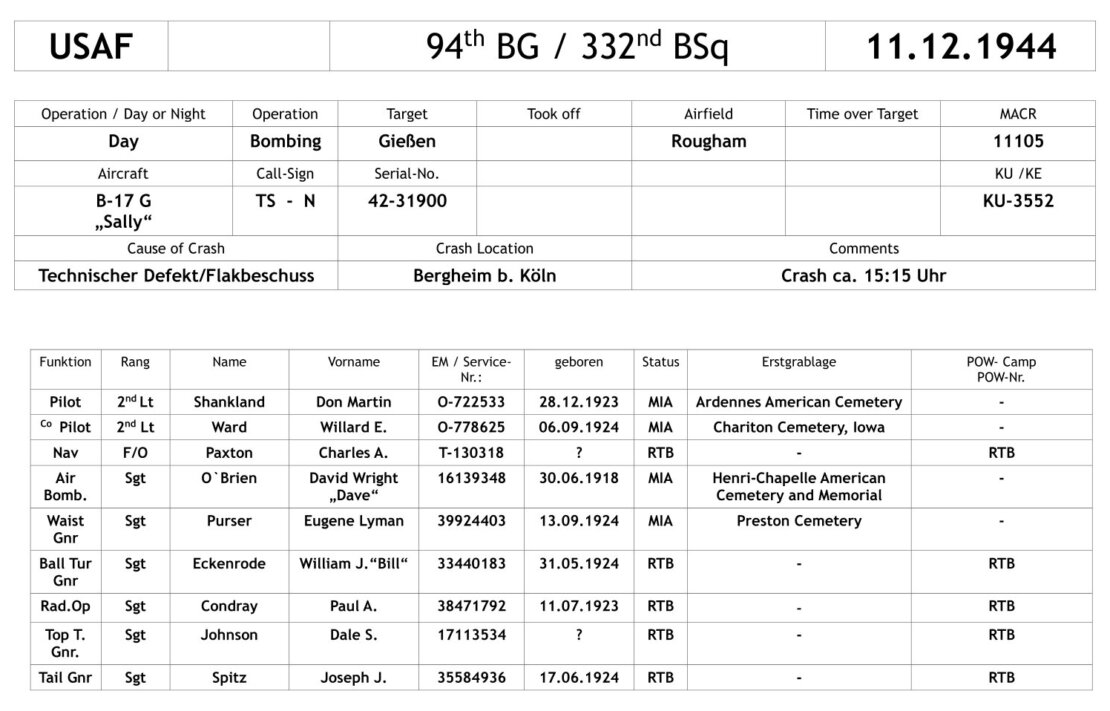
Shortly before reaching the bombing target, the second engine began to lose oil. The pilot set the second engine to idle after dropping the bombs. Then engine No. 1 went out of control and, after some difficulty, was finally brought to idle. Engine No. 3 is also not delivering full power. The aircraft is losing approximately 300 feet per minute in altitude. All equipment was jettisoned to save weight. They attempted to reach Liège, but realised this was not possible.
Consequently, several crew members bailed out on the pilot’s orders at 50°15′ N, 06°20′ E at around 14:10. The aircraft was flying at a right bank of approximately 20 degrees at an altitude of 2,000 feet. Visibility was approximately 200 yards, with a cloud base of 200 feet. The direction of flight was W-NW, on a heading of approximately 290 degrees.
The engineer in the upper turret, the navigator, the radio operator, the tail gunner and the gunner in the ball turret bailed out and landed less than a mile apart, right in the front lines. Troops from the 1st Army picked them up immediately, and on 13 December 1944 they were flown back to Aldermaston, England, in a C-47 from an airfield 3 or 4 miles north-west of Liège.
The aircraft crashed in an open field near Bergheim. Four crew members were killed; their bodies were recovered by American troops and buried in various American military cemeteries.
top left:
The pilot of the B-17 G, 2nd Lt. Don Martin Shankland
top right:
The co-pilot, 2nd Lt. Willard E. Ward